
Thursday, October 10, 2013
Mean Streets by Martin Scorsese
Yet another film by Scorsese, this film continues much of the same dialogue found in Who's That Knocking yet in a more developed way. One of the main characters, Charlie, is in essence an older version of J.R. in Who's That Knocking. This film also has strong ties with religion, and Scorsese himself said that the film has "'more to do with Catholicism than with being Italian-American'" (as cited in Lourdeaux 240). The first scene of the movie even talks about the idea that a person does not make up for their sins in the Church, but in the streets. The film focuses once again on the main character's struggle to reconcile his religion and culture with his real-life situations. While Charlie has good intentions, in the end he is incapable of succeeding because his religion and culture hold him back. He is in love with his friend's epileptic sister, but because of her disease and the fact that she is not a virgin he is incapable of considering here as a serious prospect, and he feels obligated to watch out for his older cousin Johnny Boy because he is family. What we see in this film however, is that he is essentially held back by his beliefs. His hopes can never truly be realized until he can break away from his "naive religious attitudes" (Lourdeaux 242). Until he does he puts himself at risk in the streets. He seems himself as a sort of priest, trying to do the "right thing," but essentially the streets don't work that way. In my opinion, in this film Scorsese is drawing a parallel between the Church and the streets and that while playing by rules is what should be done, neither "institution" plays completely in this manner.


Martin Scorsese's "Who's That Knocking at My Door?"
Who's That Knocking at My Door? is one of Martin Scorsese's earlier films, the "second" film of a meant to be trilogy beginning with Jerusalem, Jerusalem which was never produced. This second film is a documentary like film set in Little Italy, and continues the story of the character of J.R., whom in Jerusalem, Jerusalem was a young boy, and is now a young man. The film explores J.R.'s confusion about women and religion. Of course the most important part of the film is when J.R. finds out that the Girl is not a virgin to what she claims is because of a rape, and J.R's inability to reconcile his love for the Girl and his ingrained religious "beliefs". While J.R. may be truly confused by this Madonna-whore dichotomy, I find J.R.'s true dilemma is that of conformity. In reality J.R.'s "beliefs" that he can only marry a virgin are not so much beliefs as they are J.R. conforming to the expected norms of his society. The film shows J.R. among his group of friends and how they all follow the same rules in order to belong. Therefore, J.R.'s conflict is not so much that he truly believes these rules (he even decides to "marry her anyway" and "forgive" the Girl), as that he must conform to these rules as to not be ostracized by his community. J.R.'s inability to reconcile his wants and his felt obligations to the group are what finally close the relationship between the Girl and J.R. What makes the situation even more ironic is the fact that J.R. is adhering to the rules of a culture that he is almost completely removed from yet still identifies with. His "Italianess" is essentially nonexistent. He can't even pronounce the word "oggi," yet he values its rules like the ten commandments. In this sense the film also presents the struggle J.R. goes through applying these values to a situation that cannot be defined strictly within these Italian-American stereotypes. Unfortunately by the end J.R. is still unable to reconcile his cognitive dissonance. The ending scenes of the film show him in the Church trying to internally reconcile his situation.


Michelangelo Antonioni, La Notte (1961)
La Notte (1961) by Micheleangelo Antonioni is another film featuring Mastroianni as a "lost" latin lover. In the film Mastroianni is a novelist doubting his marriage to his wife Lidia. The film is another internally based film where the actions in the film serve to further the internal narrative of the film's main characters. What is interesting about this film in comparison to 8 1/2 for example, is that the marital doubts are coming from both husband and wife. It is not only the husband that is seen as a sort of "betrayer." Instead La Notte goes beyond the male figure and begins to explore Lidia's internal state as well. For example after the couple visits their dying friend in the hospital, Lidia wanders off into the city alone. The scene expresses a sense of solitude and sadness in Lidia. Nobody knew where she went and at the end even her husband begins to show concern. The film deals with the complex relationship of the couple and not only the male character. In order to understand Giovanni and Lidia as individuals in the film, we must also understand them as a couple and what we see is boredom within their marriage. A perfect example is when in hopes of livening up their evening Giovanni and Lidia go to a night club. The scene focuses and the sensual black dancer, Giovanni's interest in the dancer and the couple's lack of interest in each other. The rest of the film goes on to show how they try to find passion again. While neither actually cheats on the other, both find themselves interested in other people when they attend a lawn party at a wealthy estate.

In all the movie itself is like a narrative, relating to Giovanni's profession in many ways; Giovanni is an author who can't seem to write the narrative to his own life. At the end of the film Lidia states that the narrative of their marriage has come to an end, but Giovanni, the "narrative constructor," won't allow such an ending and promises to continue writing their story. The ending leaves us the the couple in the grass embracing each other with Giovanni's promises to fix things. The ending is rather ambiguous as the viewer is left to speculate about Giovanni and Lidia's fate. In my opinion, the ending while possibly leaving viewers unsatisfied, speaks to the reality of life; that nothing is certain and that even in our own lives we can't know how our narrative will end.

Fellini and "8 1/2"
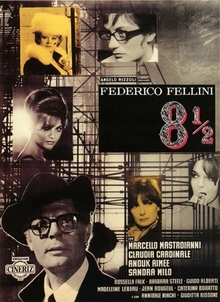

Many may ask "what happens" in this film, and the truth is that the film is not plot driven but character driven. The film is a film about making a film and the process that Guido goes through in order to find inspiration. Therefore, when watching this film one may need to put aside their common notions about what a film should be, and watch 8 1/2 for its value a film and not only a story on a screen. The cinematography is well done, the music well placed, the actors well casted. The film to me is like an orchestra where all the little pieces are put together to create a masterpiece. The film conveys human emotion through filmmaking instead of mere storytelling.
Subscribe to:
Posts (Atom)